What to Look for When Cho...
The choice of the correct logistics company is a key issu...
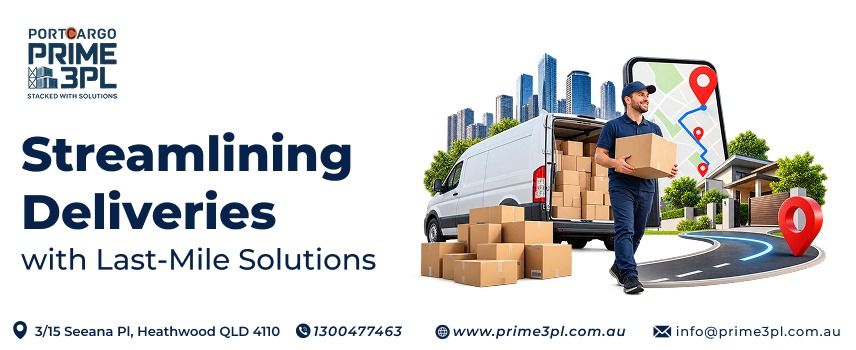
Delivery optimization is critical for businesses to be able to deliver to their customers on schedule while minimizing their logistical costs. Last-mile delivery usually involves traffic, unpredictable customer schedules, delays in delivery, and increased costs of fuel. Through effective last-mile delivery solutions, companies will be able to optimize their operations and offer customers a better experience. At Prime 3PL, we can help businesses to analyze various logistics strategies that are applicable in optimizing deliveries.
Last-mile delivery refers to the final phase of the supply chain process, where products move from a warehouse, distribution centre, or fulfillment center to the destination of the consumer. Although it may be seen as the shortest part of the delivery process, it often comprises a large portion of the total delivery cost due to factors such as traffic conditions, number of stops and failed deliveries. Effective last-mile delivery management enables companies to keep their delivery schedule and better manage their vehicles.
Delivery management can be improved through integration of order processing, dispatch, routing, and communication with customers. A properly designed delivery optimization process ensures that there is no redundant activity and allows the team to control orders effectively. Improvement can be made in the following areas:
Such improvement will simplify day-to-day operations and allow better service.
The final delivery stage may be problematic in case of a high number of orders, address changes, limited delivery hours, and road conditions which are not known to the delivery company in advance. Being aware of such issues allows one to choose appropriate last mile delivery solutions. Typical challenges faced during last mile delivery include:
Understanding these challenges allows us to plan proper improvements.
A business can enhance its delivery process by integrating appropriate technologies with effective operational strategies. The most ideal options for last-mile logistics vary depending on the number of orders, delivery destinations, vehicle capacity, and customer expectations. An organization does not have to invest in complex software programs or infrastructure upgrades in order to enhance its delivery process. It can start by making changes in routing decisions, maintaining proper addresses, and communicating effectively with customers before investing in complex systems. The below are eight such ways that an organization can benefit from.
Optimization of routes through AI takes into consideration the following: traffic information, destination of deliveries, road conditions, and vehicle capacity. The technology is able to ensure that the drivers do not travel unnecessarily. Optimal delivery route optimization has the potential of saving fuel and increasing productivity.
Real-time tracking enables eCommerce fulfillment companies in Australia to track the delivery from the point of shipping to delivery. Real-time tracking enables customers to get updates regarding their shipments. Improved visibility of shipments enables teams to react promptly to any challenges, whereas last-mile delivery technology enables better communications.
The automated dispatching system assigns delivery work based on the driver's availability, location, capacity, and workload. The system makes manual coordination easier and makes operations efficient. While an effective delivery management system ensures that orders are managed efficiently, the last-mile delivery management system ensures that teams manage their exceptions efficiently.
Predictive Delivery solutions use traffic patterns, distance of travel routes, and data about previous deliveries to calculate the time of delivery. Periodic updates will allow consumers to manage their schedule and be ready for deliveries. On-time delivery notifications will improve the communication process and improve the business reputation.
Order Batching involves merging the right orders into one delivery because of their location, delivery time window and the vehicle capacity. It eliminates repetition in delivery and improves driver efficiency. Efficient order batching along with efficient routing will help companies manage their transportation expenses.
The local warehousing in brisbane and micro-fulfillment centers store the products near the consumers; this helps the firms reduce the delivery distance of the products. Good local distribution will enable the company to have more availability of the products as well as proper handling of the orders. However, firms need to look at the costs of storing the products before introducing micro-fulfillment centers.
Delivery confirmation is proof of the successful completion of a shipment, which is accomplished by means of electronic signatures, photos, timestamps, or contact information of the receiver. The delivery confirmation will help the organizations verify the deliveries and resolve any disputes quickly. The electronic delivery confirmation will not use any papers, while digital delivery confirmation will facilitate communication.
Reverse logistics deals with returns, exchanges, and any items that have been damaged, taking them back to an appropriate destination. This can be improved through an efficient reverse logistics procedure and will help in managing extra costs, while analysis of failed deliveries will help avoid repeat journeys.
Improvement in the last mile of delivery will have advantages for the whole supply chain process. Companies that have optimised the last mile of delivery will be able to offer better services and still control operating costs. The advantages are as follows:
The effectiveness of this approach depends on the ordering pattern and operation planning.
In terms of logistics, such technologies will redefine route planning, driver allocation, expected time of delivery, and managing delivery exceptions. These systems are able to process huge data sets and find specific patterns, which might be overlooked in case of manual planning. Thus, AI-powered logistics will offer the option of changing the route due to changing traffic conditions, whereas automated delivery management will be able to allocate additional orders according to capacity. Human monitoring will still be needed for any unusual cases.
The selection of an appropriate technology requires extensive analysis of business requirements, not just the adoption of technology because it is cutting-edge. For a successful last-mile delivery, it is important that the technology used should fit into the ongoing operations and be of added value. This is what you need to look out for:
Prime 3PL can be reached on 1300477463 regarding logistics needs.
To implement an effective delivery strategy, the first thing to do is know where you stand and improve bit by bit. There should be some well-defined objectives set before spending on last-mile delivery tools. A delivery improvement program could consist of the following steps:
Periodic reviews will ensure that the business is on track.
The key performance indicators help organizations determine how effective their delivery approach is proving to be. Keeping track of KPIs related to last-mile deliveries gives an insight into decision making, and delivery performance KPIs show areas that need improvement. Some of these critical metrics include:
Various industries will have different requirements for delivery, hence the logistics solution chosen needs to cater to that industry type and its needs. Businesses involved in e-commerce may have high needs for fulfillment, delivery choices, and returns. For instance, retailers will consider store fulfillment and local deliveries, whereas third-party logistics will handle the logistics activities of several customers. The right logistics solution for 3PL will incorporate the aspects of scheduling, tracking, storage, and reporting. Prime 3PL will aid companies in discussing their logistics needs.
Businesses will risk wasting time and money when implementing new delivery processes without proper planning. Not making common errors will enable businesses to improve their last-mile delivery process and help reduce logistics costs sustainably. These are some common errors that businesses should avoid while developing their last-mile delivery process:
Making sure not to make these errors makes it easier for businesses to create more efficient delivery processes.
Making the final phase of delivery more efficient is important for ensuring cost control, reliability in delivery, and superior customer service. Through route optimization, real-time tracking, automated dispatch, and reverse logistics, among other methods, a business can achieve efficiency in day-to-day operations. A business needs to start by pinpointing its delivery problems, selecting the right solutions, and assessing its performance using appropriate performance indicators. Contacting Prime 3PL on 1300477463 will help in assessing the needs of the business in logistics.
A. Last-mile delivery solutions help businesses manage the final stage of delivery through route planning, real-time tracking, automated dispatch, and efficient shipment handling.
A. Businesses can streamline deliveries by optimizing routes, automating dispatch, tracking shipments, improving customer communication, and managing delivery schedules effectively.
A. Last-mile delivery connects businesses with customers. Efficient delivery operations help reduce delays, control costs, improve customer satisfaction, and maintain reliable supply chain performance.
A. These solutions help reduce fuel expenses, avoid unnecessary trips, improve vehicle utilization, and minimize failed delivery attempts through better planning and coordination.
A. AI helps analyze traffic, delivery locations, and order volumes to suggest efficient routes, predict arrival times, and support better delivery planning.
A. Common technologies include GPS tracking, route optimization software, automated dispatch systems, AI-powered planning tools, digital proof of delivery, and real-time tracking platforms.
A. Businesses can reduce failed deliveries by verifying addresses, sending timely customer notifications, offering suitable delivery windows, and providing accurate tracking updates.
A. Important KPIs include cost per delivery, on-time delivery rate, first-attempt delivery rate, average delivery time, failed delivery rate, and vehicle utilization.
A. A third-party logistics provider can support delivery coordination, transport planning, shipment tracking, and distribution management to help businesses improve efficiency and manage logistics operations.
A. Businesses should consider delivery volume, operating costs, service areas, software integration, tracking features, scalability, and customer requirements before selecting a suitable solution.

The choice of the correct logistics company is a key issu...
Logistics is an indispensable tool that helps businesses...
In business, there is a need for an efficient supply chai...
Discover our logistics, warehousing, fulfillment and supply chain solutions designed to support businesses of every size.

From a single parcel to full truckloads. we ensure your shipments reach their destination - safely and on time.

we get back to you within one business day.

Your goods are protected every step of the way.

Dedicated logistics specialists ready to help
Welcome to WhatsApp Chat and Share. Contact us if you need help.
Oprational Manager All Sales