Overview of Australia’s L...
The logistics industry in Australia is one sector that as...
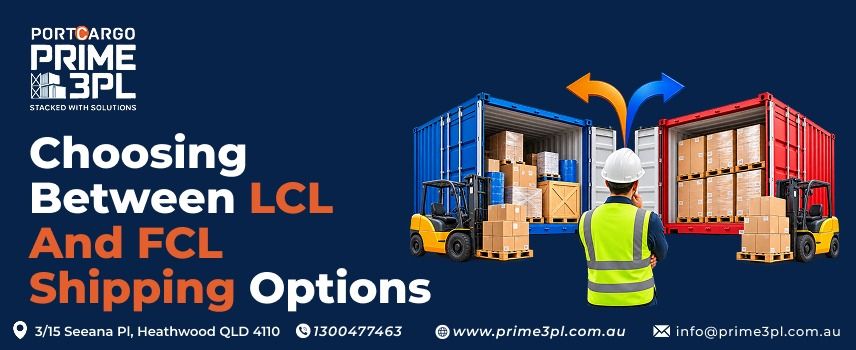
Selecting the right shipping option becomes necessary for businesses trying to control their freight costs, make timely deliveries, and save themselves from extra costs. If businesses have to ship their goods through sea routes, then they will normally have to choose from two options: LCL and FCL shipping. Depending on the volume of cargo, budget, delivery schedules, and other factors, they can decide which of the options would suit them better. Prime 3PL assists businesses in this task.
Less than Container Load (LCL) shipping is a process where your cargo shares the container with the cargo belonging to other companies. LCL shipping is ideal in situations where your cargo is not enough to completely fill the shipping container. The cost of transport is based on how much space the cargo occupies. As such, it becomes easier for smaller companies to use the LCL freight shipping service. However, it can impact the delivery period due to handling of the cargo.
Full-Container Load (FCL) freight shipping involves renting out an entire shipping container for your freight. Your freight will not be shipped together with other freight in the same container, regardless of whether the shipping container is fully loaded or not. The best example of such shipments is that of businesses with huge amounts of freight or those who have frequent international orders.
The difference between LCL and FCL is essential for organizations when selecting the best mode of transport for the shipment. Both modes can be used for international sea freight; however, the way in which both are performed is quite different. The following table gives information about the aspects that need to be considered before booking a shipment.
|
Comparison factor |
LCL shipping |
FCL shipping |
|
Container space |
Shared with other shippers |
Entire container booked for your cargo |
|
Best suited for |
Small and medium-volume shipments |
Large-volume shipments |
|
Pricing method |
Usually based on chargeable volume or weight, subject to the rate structure |
Usually priced per container |
|
Cargo handling |
More consolidation and deconsolidation |
Generally fewer shared-cargo handling stages |
|
Transit time |
May take longer due to consolidation |
May be faster on comparable routes |
|
Shipment flexibility |
Useful for smaller, frequent orders |
Useful for larger planned orders |
|
Cargo control |
Shared container arrangements |
Dedicated container space |
|
Cost efficiency |
Often suitable for smaller loads |
May offer better value for larger loads |
Shipping costs are based on factors such as cargo quantity, transport route, handling costs, port charges, and services offered in the freight quotation. LCL shipping costs are normally calculated on the basis of the amount of space/chargeable weight utilized. FCL shipping costs are normally charged per container. It is not advisable to only compare the basic freight cost as it could give a wrong perception; therefore companies should consider other costs at the origin and destination.
|
Cost factor |
LCL shipping |
FCL shipping |
|
Basic freight charge |
Based on chargeable cargo volume or weight |
Based on container type and route |
|
Small shipments |
Often more economical |
May cost more if space remains unused |
|
Large shipments |
Costs may increase with cargo volume |
May offer better overall value |
|
Handling charges |
Consolidation and deconsolidation charges may apply |
Container-related handling charges may apply |
|
Destination expenses |
May include warehouse and cargo handling fees |
May include terminal and container handling fees |
|
Best way to compare |
Calculate the complete cost for your cargo |
Compare the total container cost with the LCL quote |
Delivery time will depend on several factors, such as the shipping path, the schedule of the vessel, the congestion of the ports, the process of clearing customs, and the movement of the cargo inland. The FCL shipping transit time might be shorter compared to the LCL shipping transit time due to the fact that the container is shipped as one consignment. None of them is faster.
|
Transit factor |
LCL shipping |
FCL shipping |
|
Cargo preparation |
Requires consolidation with other shipments |
Cargo is loaded into a dedicated container |
|
Origin handling |
May require delivery to a consolidation warehouse |
Container loading may take place at the shipper's premises or a facility |
|
Port departure |
May depend on consolidation schedules |
Depends on container readiness and vessel schedules |
|
Destination handling |
Deconsolidation is generally required |
Container is released for onward delivery |
|
Delivery planning |
Allow extra time for cargo handling |
May offer a more direct handling process |
|
Main delay risks |
Consolidation, deconsolidation, and customs |
Vessel schedules, customs, and container availability |
LCL freight shipping is ideal in cases where there is not sufficient cargo from your company to fully occupy the freight container. In this case, you will be able to ship less cargo without having to pay for the whole shipping container. The considerations in deciding on LCL shipping should be cost and time of delivery and handling.
If the amount of your cargo is large enough to load the entire container, FCL would be the best choice for you. FCL could help businesses manage the bulk shipment as well as control the loading of their containers. It is necessary to compare the cost of the whole shipment as well as the size of the container.
Selecting an appropriate mode of transport goes beyond just considering the cost of shipping the cargo. Shippers must also take into account the size of the consignment, schedules for delivery, the cargo type, and the full cost of transport. The LCL and FCL shipping methods have various advantages that depend on the above considerations. Prime 3PL will assist shippers in evaluating the needs of their logistics process and determine whether they would fit the chosen mode of shipping.
The size of the shipment can help companies make a decision regarding the choice between FCL and LCL. Still, there is no certain volume of cargo after which FCL would become cheaper than LCL in all cases. There is a difference in FCL vs LCL shipping costs that depends on the route, container pricing, cargo size, and other factors. The following are some examples of how you can begin comparing various shipping methods.
Businesses can face unexpected expenses when they select a shipping method without reviewing all the costs and delivery requirements. A low initial freight quote does not always mean a lower final bill. A comparison between the full service and an understanding of the shipping process will assist in minimizing costs in international freight shipping.
Companies might have to incur some unforeseen charges if they opt for a particular freight option without analyzing the costs associated with it. In fact, an initial charge that is lower doesn’t necessarily lead to lower overall charges. It would be helpful for a company to analyze the services in detail to avoid unnecessary costs while arranging international freight shipping.
Choosing LCL and FCL depends on the cargo you have as well as the cost of transporting your goods. LCL may work for a small consignment, whereas FCL will be a better option for larger consignments that require a dedicated container. A comparison of full freight quotations will provide you with practical insight into which mode of transport will work for you, not just the cost factor alone. Prime 3PL can help you to assess your logistics requirements and determine your mode of transport. Please call us at 1300477463.
A. LCL shipping allows multiple businesses to share container space, while FCL shipping provides an entire container for one shipper's cargo, even if it is not completely full.
A. LCL shipping is usually more affordable for small shipments because you pay for the space your goods occupy. FCL may be more cost-effective when shipping larger cargo volumes.
A. FCL shipping can be faster because it generally involves fewer shared-cargo handling steps. LCL may take longer due to cargo consolidation and separation at the destination.
A. Compare your cargo volume, total shipping costs, delivery deadlines, and handling requirements. Request quotes for both options to find the most suitable solution for your business.
A. CBM stands for cubic metre, a unit used to measure cargo volume. Freight companies use cargo dimensions and weight to calculate charges and plan suitable shipping arrangements.
A. There is no fixed shipment volume for every route. Compare the total LCL charges with the complete FCL container cost to determine which option offers better value.
A. Yes, LCL shipping can be suitable for fragile goods when they are packed properly. However, shared cargo may involve additional handling, so suitable packaging is important.
A. Yes, you can book an entire container even if your cargo does not use all the available space. The charges generally apply to the container rather than only the space occupied.
A. Additional charges may include cargo handling, documentation, port fees, customs-related services, and inland transportation. The final cost depends on the route and services included in your quote.
A. Prime 3PL helps businesses review their cargo volume, delivery schedules, and logistics requirements to explore suitable
The logistics industry in Australia is one sector that as...
Selection of a right logistics company could directly aff...
Discover our logistics, warehousing, fulfillment and supply chain solutions designed to support businesses of every size.

From a single parcel to full truckloads. we ensure your shipments reach their destination - safely and on time.

we get back to you within one business day.

Your goods are protected every step of the way.

Dedicated logistics specialists ready to help
Welcome to WhatsApp Chat and Share. Contact us if you need help.
Oprational Manager All Sales