Black Friday and Christma...
Black Friday and Christmas are two of the busiest shoppin...
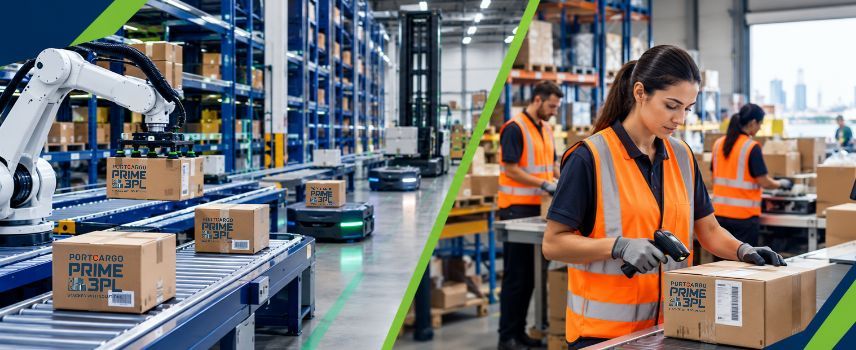
Choosing between automation of warehouse activities and doing everything manually is an important stage for every company that has to store, pack, and ship its products. If the correct choice is made, there will be a possibility to decrease the cost of operations, to improve the accuracy of order processing, and to manage the inventory without difficulties. However, every warehouse is characterized by specific needs. While some companies find it convenient to use automated systems and special software, other companies prefer to depend on qualified personnel. Prime 3PL helps to understand the needs of warehousing and logistics.
Automation in the warehouse involves the use of machinery, computers, and other technologies in performing the functions in a warehouse with minimum manual intervention. The technologies used include handling of inventories, product handling, picking of orders, sorting, and packaging of the product for dispatch. Some examples of such technologies include conveyors, barcode scanners, automated storage technologies, and warehouse management systems. Use of the right technology will increase speed of work and minimize errors due to monotonous activities.
The manual system in a warehouse is one where staff members do the tasks on a day-to-day basis with the help of their knowledge, experience, and minimal technology. The tasks that fall under this category include receiving, inventory checking, storage, picking, packing, and shipping. This system is mostly suited to smaller organizations and small order volumes as it does not require a large investment in technology. In addition to this, it allows the staff to cope with any irregularity in product types and customer demands.
The key distinction between these two methods is how the tasks in the warehouse are accomplished. In automated processes, technology is used for certain tasks, whereas in manual warehouses, labour is the primary consideration. The appropriate choice would depend on the operating cost, order size, range of products, and delivery requirements.
The introduction of warehouse automation involves expenditure on equipment and software. The cost of manually operating a warehouse is comparatively low to start with, though wages may add up to total costs. In any case, it depends on the type of workload and costs involved.
A warehouse automation process does not involve as much repetitive work and requires trained workers to operate and maintain it. The manual method of operating a warehouse is dependent on the availability, performance, and experience of workers.
The order picking speed increases as a result of the introduction of scanning devices in warehouse automation systems. In manual methods of order fulfillment, order picking lists must be followed carefully.
Automation of inventory management will ensure that any movement of stock is noted and recorded instantly. However, in manual inventory management, workers have to count products and record them, an activity that can lead to some delays or mistakes unless they are checked for.
Through automated warehouse management systems, storage capacity can be increased by adopting the vertical method of storage and systematic handling of products. Manual warehouse operation uses racks, shelves, and forklifts hence good when space and movement of the products is manageable.
Manual operation of the warehouse ensures that there is flexibility in terms of hiring more workers due to seasonal changes in demand. Automated warehouse management is efficient in dealing with the workload whenever adequate capacity is available.
Warehouses that have automation systems can handle large order quantities, although they may need equipment upgrades. Manual warehouses can increase their size with additional employees, although the expenses and managing work may become difficult for the expanding company.
Automation of the warehouse lowers the hazards of manual handling and lifting but involves machinery hazard control. Manual operation of the warehouse may be exposed to the dangers of lifting, slipping, and falling.
The table below illustrates some of the important considerations to take into account.
|
Comparison factor |
Warehouse automation |
Manual operations |
|
Initial investment |
Usually higher |
Usually lower |
|
Operating costs |
Includes software, maintenance, and equipment |
Includes wages, training, and basic equipment |
|
Work speed |
High for suitable repetitive tasks |
Depends on workforce size and workload |
|
Order accuracy |
Can improve through scanning and system checks |
Depends on staff training and checking methods |
|
Inventory tracking |
Can provide faster, real-time updates |
May require more manual entries |
|
Space utilisation |
Can support high-density storage |
Depends on warehouse layout and handling methods |
|
Flexibility |
May need system changes for new tasks |
Workers can adapt quickly to varied tasks |
|
Scalability |
May require additional equipment or capacity |
May require more workers and floor space |
|
Safety |
Reduces some repetitive manual handling |
Depends on safe work practices and equipment |
Automation may enhance efficiency within warehouses provided that the automated system is suited to the tasks involved. Automation comes with setup expenses and technicalities that should be considered by the organization. Examination of the pros and cons of automated warehouses will aid organizations in determining if such an investment suits them.
|
Pros |
Cons |
|
Faster handling of repetitive tasks |
Higher initial investment |
|
Better inventory visibility |
Requires technical support |
|
More consistent order processing |
Maintenance can cause downtime |
|
Less repetitive physical work |
Staff training is necessary |
|
Supports higher order volumes |
Changes may require system upgrades |
The manual method provides an efficient way for firms to begin when they seek flexibility without a huge investment in sophisticated machinery. The manual method allows for adaptability in dealing with strange orders and variable product demands. But the problem is that the firm will find it difficult to cope with large volumes of work when using only human effort.
|
Pros |
Cons |
|
Lower initial investment |
Higher dependence on staff availability |
|
Easy to adjust task assignments |
Processing may be slower |
|
Suitable for varied product handling |
Greater chance of manual errors |
|
Fewer technical requirements |
Stock updates may be delayed |
|
Simple to start on a small scale |
Labour costs may rise with demand |
Cost comparisons need more than a simple check on the cost of the equipment or the payroll for the month. Automation cost considerations can range from installation and software, to maintenance and training costs, and any future upgrades to the system. Cost considerations for manual warehouses would cover labor costs, overtime, the cost of equipment, mistakes, and the time wasted on repetitive actions. It is important for the company to calculate these costs over a period of three to five years using real-world workloads.
There is no need for businesses to automate all warehouse processes immediately. A more reasonable way of doing things is to find those processes which are time-consuming, repetitive, or error-prone. The introduction of warehouse process automation can start with minor solutions, like barcodes or inventory tracking software, before proceeding to more complicated ones. The order fulfillment automation can be beneficial if the large number of orders leads to delays in their processing.
Automation might be useful in case there is a high volume of orders being processed, regular workflow processes or labour shortages. This solution might be useful for those companies which lack information about their inventory levels or have problems with order processing. Warehouse automation solutions may become reasonable when there are problems with repeating processes which result in delays and mistakes. Warehouse efficiency solutions have to be chosen depending on products, budget, available space and demand levels.
Manual systems can prove appropriate for small-scale businesses having low budgets, small order quantities or goods requiring individual treatment. Manual systems enable employees to switch between tasks without dependence on machinery. Manual warehouse management systems can also prove appropriate for firms experiencing constant changes in their orders or processes that cannot be standardized. Labor management in the warehouse is important since clearly defined responsibilities, employee training and proper inventory records ensure efficiency. Small-scale businesses can continue using manual methods until such time as when it becomes necessary.
Hybrid warehouses utilize the combination of human laborers, basic machinery, and some automated systems. This implies that workers might be responsible for receiving and inspecting products while the inventory is managed by computer software, and barcode scanners assist in picking products. Such a strategy enables businesses to enhance the particular process without changing the overall business system. Hybrid warehouses can be helpful to businesses that need to make gradual improvements without overspending. Partial automation of the warehouse helps firms capitalize on human flexibility and reduce manual work.
Unwise investment into technology without an understanding of warehouse-related problems can cause wastage of money and inefficient implementation. Having a good plan can ensure companies avoid making the mistakes that are commonly made.
Decision between warehouse automation and manual systems will be based on one’s budget, workload, staffing requirements, and future plans. The manual system may serve very well for small warehouses, but the automated system could bring more efficiency in performing repeated and voluminous tasks. Hybrid options may also serve as an effective compromise. Prime 3PL will assist organizations in finding their warehousing and logistics requirements. For inquiries, get in touch with Prime 3PL at 1300477463.
A. Warehouse automation uses machines and software to handle warehouse tasks, while manual operations depend on workers to manage stock, pick orders, pack products, and prepare shipments.
A. Warehouse automation suits businesses with high order volumes and repetitive tasks. Manual operations may work better for small businesses with limited budgets and changing requirements.
A. Warehouse automation improves work speed, order accuracy, inventory tracking, and space utilisation. It also reduces repetitive work and helps businesses manage increasing order volumes.
A. The main disadvantages include high setup costs, regular maintenance, technical issues, and staff training requirements. Businesses must also budget for software upgrades and equipment repairs.
A. Manual operations generally require less initial investment. However, labour costs, overtime, stock errors, and slower processing can increase expenses as the business grows.
A. Automated inventory management uses software and scanning tools to track stock movements and update records. This helps businesses monitor product availability and reduce inventory errors.
A. Businesses can start with repetitive tasks such as barcode scanning, inventory tracking, order picking, packing, and sorting. The best choice depends on where delays and errors occur most often.
A. Yes, a hybrid model combines manual work with selected technology, such as inventory software and barcode scanners. It helps small businesses improve efficiency without investing in full automation.
A. Businesses should compare the total investment with savings from labour, fewer errors, faster order processing, and better space utilisation. Maintenance, training, and operating costs should also be considered.
A. Prime 3PL helps businesses understand their warehousing and logistics requirements and explore suitable solutions. For enquiries about your business needs, contact Prime 3PL at 1300477463.

Black Friday and Christmas are two of the busiest shoppin...


The choice of the correct logistics company is a key issu...
Discover our logistics, warehousing, fulfillment and supply chain solutions designed to support businesses of every size.

From a single parcel to full truckloads. we ensure your shipments reach their destination - safely and on time.

we get back to you within one business day.

Your goods are protected every step of the way.

Dedicated logistics specialists ready to help
Welcome to WhatsApp Chat and Share. Contact us if you need help.
Oprational Manager All Sales